
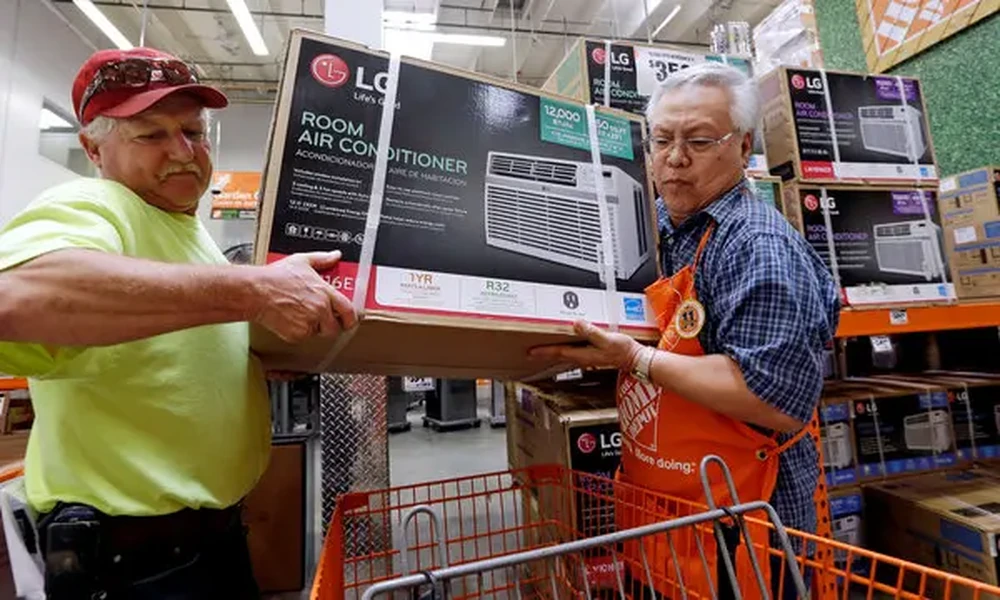
Ninety percent of American homes now depend on technology that was, within your grandparents’ lifetimes, considered an exotic luxury for the very wealthy. The spread of residential air conditioning is one of the fastest adoption stories in the history of consumer technology, and it reshaped where Americans chose to live, how they built their houses, and what they expected out of a summer afternoon.
Understanding how that happened makes you a smarter homeowner today. Because the arc of AC history runs straight from Willis Carrier’s industrial boiler rooms right into the decision you’ll eventually face: keep the unit running or call it done.
Before the Window Unit, There Was Literally Nothing
Willis Carrier invented mechanical air conditioning in 1902. The technology wasn’t dreamed up for your comfort. It was built to control humidity in a Brooklyn printing plant so that paper wouldn’t warp and ink would stay aligned through New York’s humid summers. Comfort was an accidental discovery.
For the next four decades, AC lived almost entirely in commercial spaces. Movie theaters were the most famous use case. Hot New York summers drove locals indoors specifically because theaters had cooling systems, and historians credit this migration with inventing the concept of the summer blockbuster. Department stores, office buildings, and hospitals adopted the technology through the 1930s and 40s, but homes were a different story entirely.
The first room air conditioner built for residential use appeared in 1932, and its price tag was staggering relative to average wages. Manufacturing remained expensive, compressors were loud, and the average postwar bungalow wasn’t designed around the idea of mechanical cooling at all. According to the U.S. Energy Information Administration, 48 percent of all energy consumption in American homes results from cooling and heating combined , a figure that reflects just how central these systems have become, though in 1945 that sentence would have been nearly meaningless for most families. You can trace the full arc of the technology through the U.S. Department of Energy’s history of air conditioning, which documents each turning point from Carrier’s first patent forward.
The 30-Year Sprint That Changed Everything
The real story begins in 1955. Postwar prosperity had put factories back to work, and mass production had finally pulled room air conditioner prices down to something a middle-class household could consider. What followed was extraordinary.
In 1955, fewer than 2% of the nation’s residences had any form of air conditioning. By 1980, over half were air conditioned, and over a quarter had central air , according to research published in the journal Explorations in Economic History on the spread of residential AC between 1955 and 1980. That’s a jump from near-zero to majority adoption in a single generation. No other home appliance moved that fast across that wide a population. The peer-reviewed study documents this regional adoption data across every U.S. census division.
Geography mattered enormously. The South led the charge, driven by humidity and heat that made comfort genuinely difficult without mechanical cooling. Texas, Oklahoma, and Louisiana were among the first states to hit high adoption numbers. The Northeast lagged, partly because its milder summers made the investment harder to justify, and partly because older housing stock in those states was built with thick walls and shade trees rather than ductwork.
“The years between 1950 and 1980 saw the transformation of residential air conditioning from a rare luxury to a common feature of American life.”
Explorations in Economic History, 2008, as cited in peer-reviewed research on U.S. residential cooling adoption
Central air conditioning, the kind that moves through your home’s ductwork and conditions every room at once, didn’t really arrive in new home construction until the late 1960s. Before that, you bought window units room by room. The shift to central systems changed how builders designed floor plans, how home prices were calculated, and how buyers evaluated properties.
Where Things Stand Right Now
The adoption curve has essentially flattened because there’s almost nowhere left to grow. According to the U.S. Energy Information Administration’s 2020 Residential Energy Consumption Survey, 88% of U.S. households use air conditioning. That number is essentially a ceiling given that the holdouts are concentrated in Alaska, along the temperate Pacific Coast, and in older apartment buildings where installation is structurally complicated.
The Midwest and South Census Regions had the highest percentages of households using AC in 2020, at 92% and 93% respectively , according to that same EIA survey. Ohio, which sits in the Midwest region, fits squarely in that high-adoption band. Summers in Dayton and Cincinnati are genuinely humid and hot enough that a home without cooling isn’t really a comfortable home from June through August. The full EIA 2020 RECS report breaks this down further by housing type, climate region, and construction era.
The other shift worth noting is generational. Homes built before 1950 lag in AC adoption because retrofitting ductwork into an older structure is expensive and sometimes structurally impractical. Newer construction almost universally includes central systems from the foundation up. If your home is 70 years old and still running the window unit your parents installed, you’re part of a shrinking cohort.
The Repair-or-Replace Decision: A Practical Framework
Here’s where history becomes personal. Most central AC systems last between 15 and 20 years under normal use. The country’s massive mid-century and 1980s installation wave means a huge share of operating systems are either already past their prime or approaching it fast.
Use what HVAC professionals call the 5,000 Rule to make the call: multiply the unit’s age in years by the estimated repair cost in dollars. If that number exceeds 5,000, replacement almost always wins on cost over the next five years. If it comes in under 5,000, a quality repair makes financial sense.
| Unit Age (Years) | Repair Quote | Age x Cost | 5,000 Rule Verdict |
|---|---|---|---|
| 5 | $600 | $3,000 | Repair |
| 10 | $450 | $4,500 | Repair |
| 14 | $380 | $5,320 | Replace |
| 16 | $700 | $11,200 | Replace immediately |
Consider what we can call The Dayton Scenario: a 15-year-old central unit cools the house fine for nine months of the year, but every July it struggles and throws an error code. A technician quotes $520 to replace the capacitor and recharge refrigerant. That’s 15 x $520, or $7,800 on the 5,000 Rule. The math says replace. But if that same tech quotes $180 to clean the coils and adjust the refrigerant level, the calculation becomes 15 x $180, or $2,700. Repair wins.
The variable no table captures is technician quality. A good diagnosis before any repair quote is worth as much as the rule itself. Homeowners who need AC repair in Cincinnati, OH, benefit most from a certified technician who can separate a genuine end-of-life system from a unit with years of service left that just needs a targeted fix.
The Honest Bottom Line
Air conditioning went from a factory humidity solution to a fixture in nearly every American home in roughly 60 years. That adoption wave created the modern expectation of year-round comfort, changed American migration patterns, and built an entire service industry around keeping these systems alive.
Your system is one node in that 120-year arc. The question isn’t whether it will eventually need replacing. It will. The question is whether the unit in your attic right now has another season or another decade left, and the only way to answer that honestly is with a technician who treats the diagnosis as seriously as the repair itself. What’s your unit telling you this summer?

Comments are closed.